
A doctor has just referred the newborn for a ‘brainstem audiometry test‘ and the parent is nervous and confused. This confusion is because of the unawareness of the test. It is conducted to detect whether an infant has hearing loss. The procedure is completely painless and safe. A similar one, OAE test (Otoacoustic Emissions) is also conducted along with the other as a two-step diagnostic process.
The blog discusses brainstem evoked response audiometry test and what to expect during the test.
What Is a Brainstem Evoked Response Audiometry Test?
The Brainstem Auditory Evoked Response Test (BERA) records your brain’s electrical activity in response to clicking sounds to evaluate the health of your auditory nerve and brainstem. This is a non-invasive and painless neurological test done using scalp electrodes. The test usually takes 30 to 60 minutes. In babies, the test is usually conducted in a hearing care clinic while sleeping or mildly sedated. It is also known as Auditory Brainstem Response (ABR).
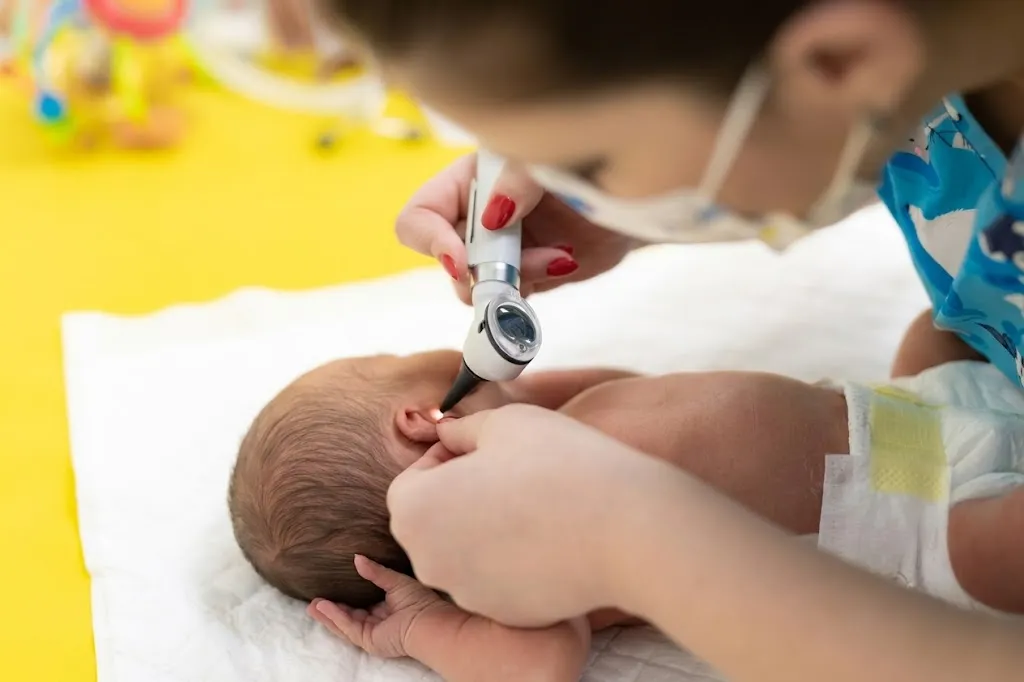
How Does a Brain Stem Hearing Test Work?
Step 1
Electrode placement: Small, painless electrodes are attached to the baby’s scalp, forehead, and earlobes.
Step 2
Sound delivery: Tiny earphones play soft click or tone-burst sounds into each ear.
Step 3
Brain response recording: The electrodes detect and record electrical activity (waveforms) produced by the auditory nerve and brainstem.
Step 4
Waveform analysis: An audiologist reads five key waves (I to V). Delays or absent waves reveal problems.
Step 5
Result interpretation: Results are typically shared the same day, classified as normal or requiring follow-up.
Why Is the BERA Test Done for Newborns?
Brain stem hearing test is considered as the universal newborn hearing screening Kerala. 4 to 6 babies in every 1000 babies are born with some degree of hearing loss. Early detection is possible through this test for speech and language development. An advantage is that the brain stem hearing test does not require the baby to respond or cooperate. It can be done while they are sleeping. If a baby does not pass the OAE hearing screening at birth, a BERA test is recommended to confirm whether there is any hearing impairment.
Premature birth, prolonged ventilation, and perinatal asphyxia (baby is deprived of adequate oxygen or blood flow before, during, or just after birth) raise hearing risk. Hence NICU or high-risk babies require brainstem response audiometry tests. In babies with neonatal jaundice (hyperbilirubinemia), high bilirubin levels can damage the auditory nerve. The BERA test helps detect this early. It also helps to identify speech delay or developmental delay.
Warning Signs That Your Baby May Need a BERA Test
Your baby may benefit from a brainstem response audiometry test if they:
- Do not startle at sudden loud sounds
- Do not turn their head toward familiar voices for 3–4 months
- Show no response to their own name by 6 months
- Have delayed speech or babbling milestones
- Were born prematurely or spent time in the NICU
- Had severe jaundice as a newborn
If any of the signs of hearing loss in children is detected, an early brainstem response audiometry test can give you answers. Book a BERA Test Today.
What to Expect During the BERA Test — A Parent’s Guide
Duration | 45 to 90 minutes (longer if baby wakes frequently) |
Pain / discomfort | None — electrodes are pasted on skin, not pierced |
Sedation | Not usually needed; ideally done during natural sleep or after feeding |
Preparation | Clean scalp (no oils/creams); schedule during usual nap time |
Who performs it | Audiologist or trained hearing care specialist |
Most babies sleep peacefully through the entire procedure. Parents can remain with their child throughout the test, making the experience comfortable and reassuring for both baby and parent.
Understanding BERA Test Results
Normal BERA Result
A normal result means the hearing nerve and brainstem pathways are responding as expected. In most cases, no further testing is needed unless there are continuing concerns about your child’s hearing or development.
Abnormal BERA Result — What Happens Next?
An abnormal result is not a final diagnosis. It simply indicates that further evaluation is needed. The next steps may include:
- Repeating the BERA test to confirm findings.
- Additional hearing assessments to determine the type and degree of hearing loss.
- Hearing aids or other interventions if required.
- Speech therapy support to help your child develop communication skills
Early diagnosis leads to better outcomes. Schedule a consultation today.
BERA Test vs OAE — What Is the Difference?
Test | OAE (Otoacoustic Emissions) | BERA / ABR (Brainstem Evoked Response Audiometry) |
What it checks | Outer hair cell function in the cochlea | Full auditory pathway from cochlea to brainstem |
Used for | Initial newborn screening at hospital (at birth) | Confirmatory diagnosis; high-risk infants; failed OAE |
Limitation | Cannot identify nerve or brainstem problems | Takes longer; best done when baby is asleep or still |
An OAE test checks the function of the cochlea and is commonly used as a newborn screening test. However, it cannot identify problems in the hearing nerve or brainstem. A BERA test evaluates the entire auditory pathway from the cochlea to the brainstem and is usually recommended if a baby does not pass the OAE screening.
The brainstem evoked response audiometry test is safe, painless, and one of the most important tests for detecting hearing issues early in life. Early detection of hearing difficulties can make a significant difference in a child’s speech, language, and social development. If you’ve noticed any warning signs or your baby did not pass the newborn hearing screening, don’t delay seeking professional guidance. The sooner hearing concerns are identified, the sooner appropriate support and treatment can begin.
If you have concerns about your baby’s hearing, contact Aanchal Hearing Care today and book a BERA test for babies.